I am currently a PhD candidate in the College of Agriculture and Life Sciences at the University of Florida. My research interests include labor economics, Agricultural Economics, and Technological Change. I will be entering the job market this year.
Ph.D., Food and Resource Economics, University of Florida — Gainesville, FL (expected May 2026)
M.Sc., Agricultural & Resource Economics, University of Maryland — College Park, MD (Dec 2020)
M.Sc., Applied Economics, University of Chile — Santiago, Chile (May 2015)
B.Sc., Industrial Engineering, University of Chile — Santiago, Chile (May 2015)
Abstract. We quantify how artificial intelligence (AI) innovations affect U.S. agricultural employment. Using 2003–2023 U.S. Patent and Trademark Office records, we construct a measure of agriculture’s exposure to AI by classifying AI patents and mapping them to subsectors through Cooperative Patent Classification (CPC) and North American Industry Classification System (NAICS) concordances. A shift–share design with an instrumental variable approach interacts national AI innovation trends with county-level lagged employment shares. Estimates indicate that AI exposure raises employment in crop production (NAICS 111) by 10.6% and in animal production (NAICS 112) by 6.8%, relative to mean employment levels in each subsector. Decomposing AI based on its underlying function reveals heterogeneity in employment effects. Execution-oriented AI (hardware and automation) reduces overall agricultural employment (NAICS 11) by 6.9%, while cognition-oriented AI (decision-support) and perception-oriented AI (sensing) increase employment (4.3% and 6%, respectively). These domain-specific patterns are consistent across crop and animal subsectors, with stronger employment effects in crop agriculture (-12.8% for execution-, 9.1% for cognition-, and 10% for perception-oriented AI) than in animal agriculture (-4.5% for execution-, and 7.8% for perception-oriented AI, respectively). Results show that AI does not uniformly displace farm labor; instead, its effects depend on technological complementarities and task reallocation. By uncovering domain-specific dynamics, this study demonstrates how targeted AI innovations can augment agricultural employment, informing policies that support skill upgrading and diffusion of complementary technologies.
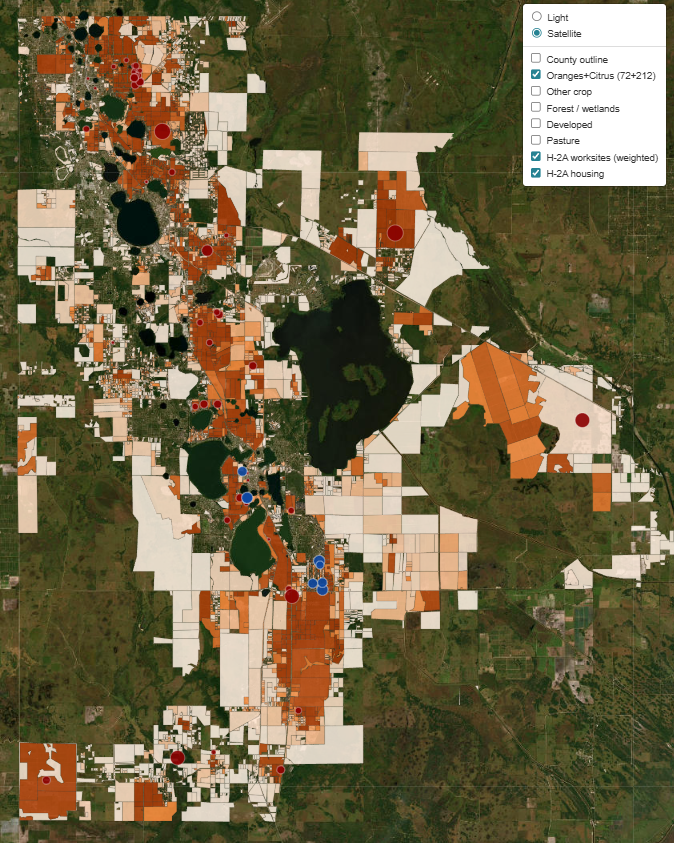
Housing and worksite H-2A spatial distribution and citrus land-use change at parcel level. Example: Highlands County, FL. Hover an image for methodology details.
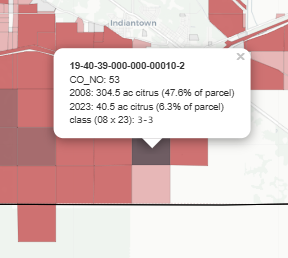
Interactive leaflet over ~150,000 parcels in Highlands County, FL. Orange+citrus coverage from USDA CDL (2023, classes 72 and 212) via a per-parcel tile-rasterization pipeline. Five land-cover categories per parcel. H-2A worksite and housing addresses from DOL OFLC 2026 disclosures, geocoded at street level. Worksite markers sized by workers allocated proportionally to grove acres; housing markers by max occupancy.Click any parcel for its 2008 to 2023 trajectory. Example from Martin County: a 304-acre grove that lost 86% of its citrus by 2023 is still classed as stable-high on a log-acres axis, illustrating why retention ratios are the right axis for the farmland-loss narrative.
LaBOR: Labor and Business Operation Risk
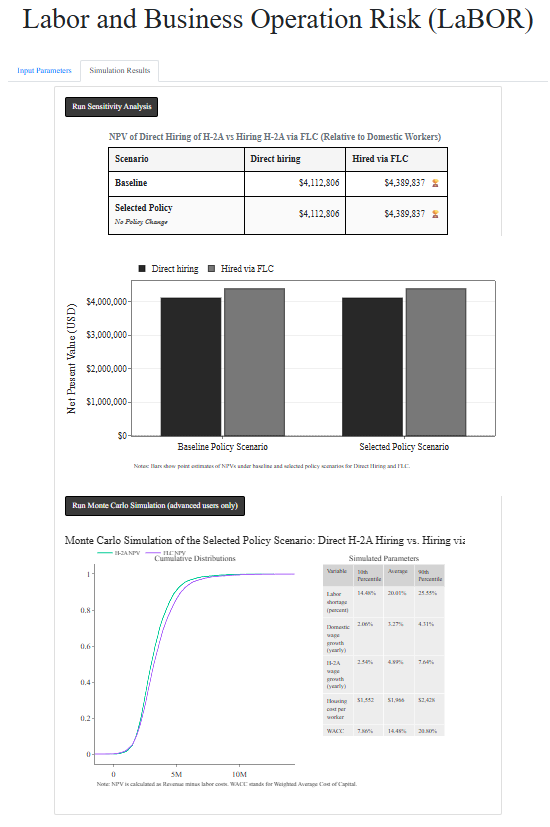
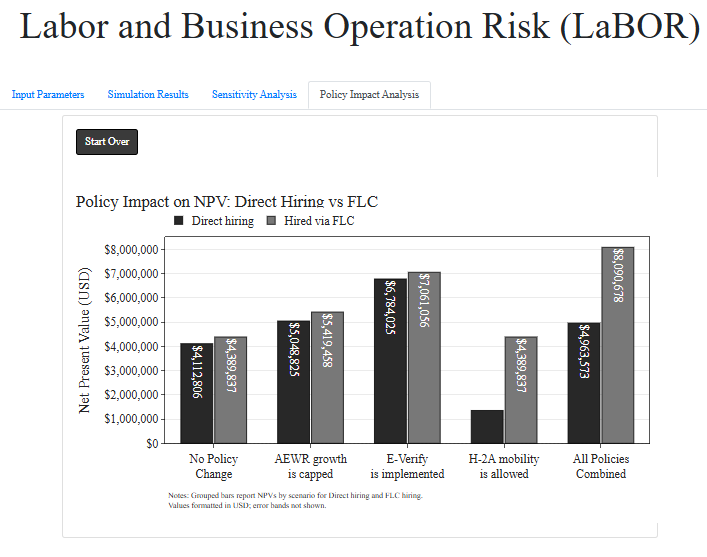
Interactive decision-support tool estimating the net present value of alternative H-2A hiring strategies (direct hiring vs. Farm Labor Contractor) relative to domestic workers. Hover an image for details.
Simulation Results view: baseline vs. selected policy NPV for direct hiring and FLC, plus Monte Carlo cumulative distributions over user-adjustable inputs (labor shortage, domestic wage growth, H-2A wage growth, housing cost, WACC).Policy Impact view: net present value under alternative policy scenarios (no change, AEWR growth capped, E-Verify implemented, H-2A mobility allowed, all policies combined) for both direct hiring and Farm Labor Contractor paths.